Hans
Walser, [20260527]
Fibonacci
Trapezoids
1
What
it's about
A
construction using equilateral triangles that leads to isosceles trapezoids in
the context of the Fibonacci sequence fn
(numbering starts with 0):
0, 1, 1, 2, 3, 5, 8, 13, 21, 34, 55, 89, 144,
233, 377, 610, 987, …
2
Step-by-step
construction
We begin
with an equilateral triangle as the base triangle (Fig. 0).

Fig.
0: Base triangle
2.1 First step
We join
two equilateral base triangles from Figure 0 according to Figure 1 and complete
them to a trapezoid. The trapezoid is isosceles and has a top length of 1, a
leg length of 1, and a base length of 2. The numbers 1, 1, 2 are part of the
Fibonacci sequence. The trapezoid consists of three equilateral triangles.

Fig.
1: First Step
2.2 Second Step
We join
two trapezoids from Figure 1 according to Figure 2 and complete them to a
trapezoid. The trapezoid is isosceles and has a top length of 1, a leg length
of 2, and a base length of 3. The numbers 1, 2, and 3 are part of the Fibonacci
sequence. The trapezoid consists of eight equilateral triangles.
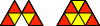
Fig.
2: Second Step
2.3 Third Step
We join
two trapezoids from Figure 2 according to Figure 3 and complete them to a
trapezoid. The trapezoid is isosceles with a top length of 2, a leg length of
3, and a base length of 5. The numbers 2, 3, and 5 are part of the Fibonacci
sequence. The trapezoid consists of 21 equilateral triangles of the same size
as the base triangle. (The large equilateral triangle consists of four base
triangles.)
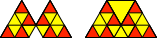
Fig.
3: Third Step
2.4 Fourth Step
We join
two trapezoids from Figure 3 according to Figure 4 and complete them to a
trapezoid. The trapezoid is isosceles with a top length of 3, a leg length of
5, and a base length of 8. The numbers 3, 5, and 8 are part of the Fibonacci
sequence. The trapezoid consists of a total of 55 equilateral triangles of the
same size as the base triangle.
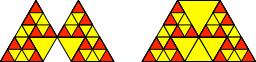
Fig.
4: Fourth Step
2.5 The Next Steps
Figures 5
to 7 show the next steps.
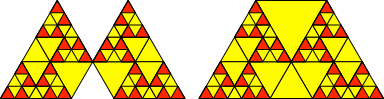
Fig.
5: Fifth Step
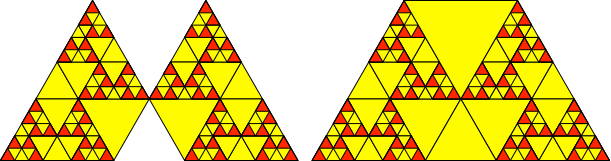
Fig.
6: Sixth Step
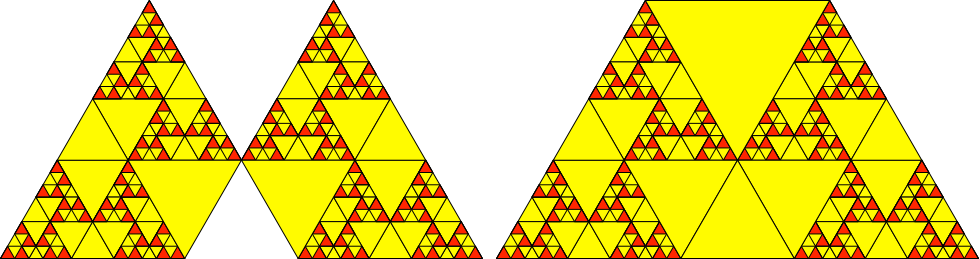
Fig.
7: Seventh Step
3
Data
Table 1
provides the initial data.
|
Step |
Deck Length |
Leg Length |
Base Length |
Number of Base Triangles |
|
0 |
0 |
1 |
1 |
1 = 1 (0 + 1) = 12 – 02 |
|
1 |
1 |
1 |
2 |
3 = 1 (1 + 2) = 22 – 12 |
|
2 |
1 |
2 |
3 |
8 = 2 (1 + 3) = 32 – 12 |
|
3 |
2 |
3 |
5 |
21 = 3 (2 + 5) = 52 – 22 |
|
4 |
3 |
5 |
8 |
55 = 5 (3 + 8) = 82 – 32 |
|
5 |
5 |
8 |
13 |
144 = 8 (5 + 13) = 132 – 52 |
|
6 |
8 |
13 |
21 |
377 = 13 (8 + 21) = 212 – 82 |
|
7 |
13 |
21 |
34 |
987 = 21 (13 + 34)) = 342 – 132 |
Tab. 1: Data
We
recognize the Fibonacci numbers.
Step n
results in an isosceles trapezoid with top length fn,
leg length fn+1, and base length fn+2.
Different formulas are possible for the number of base triangles An:
An = f2n+2
An = fn (fn–1 + fn+1)
An = fn+12 – fn–12
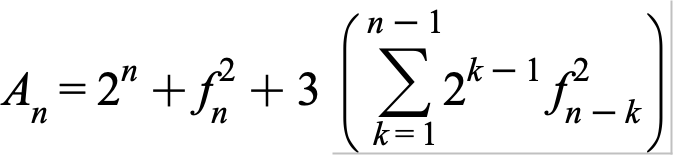
The
proofs can be carried out by calculation.