Hans
Walser, [20260528]
Golden
Fractal
1
Preliminaries
For our
construction, we need the Golden Ratio:
Φ = (1 + √5)/2 ≈ 1.618
2
The
Base Trapezoid
We work
with an isosceles trapezoid with base Φ, leg length 1, and top edge 1/Φ (Fig. 1). The
base angles measure 60°.
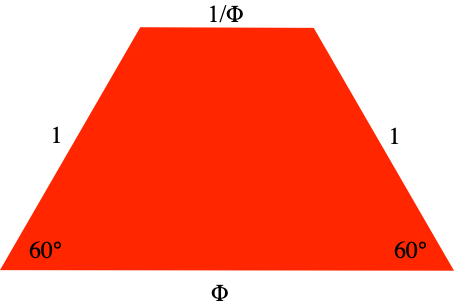
Fig.
1: Base Trapezoid
3
Construction
We reduce
the size of the base trapezoid by a factor of 1/Φ ≈ 0.618. We rotate the reduced
trapezoid once by 120° and once by –120° and join the two smaller trapezoids at
one vertex as shown in Figure 2.

Fig.
2: Reduce, rotate, and join
The
convex hull of the figure (Fig. 3.1) is congruent to the base trapezoid.

Fig.
3.1: First step
Now we
repeat the procedure of reducing, rotating, and joining (Fig. 3.2).

Fig.
3.2: Second step: Repeating the procedure
Figures
3.3 to 3.12 show the further steps. The number of red trapezoids doubles with
each step.

Fig.
3.2 Fig. 3.3: Third Step

Fig.
3.4: Fourth Step

Fig.
3.5: Fifth Step
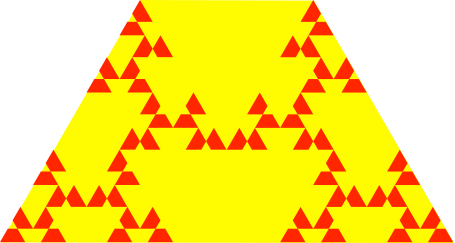
Fig.
3.6: Sixth Step
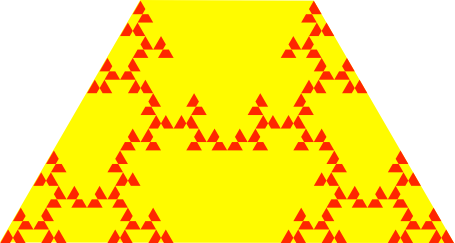
Fig.
3.7: Seventh Step
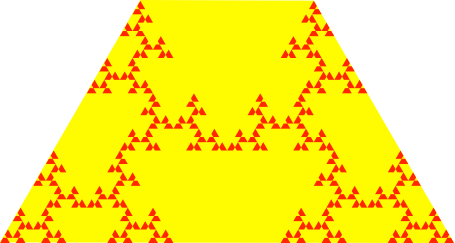
Fig.
3.8: Eighth Step
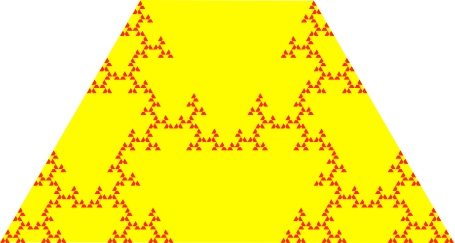
Fig.
3.9: Ninth Step
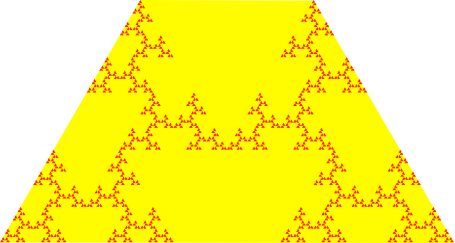
Fig.
3.10: Tenth Step
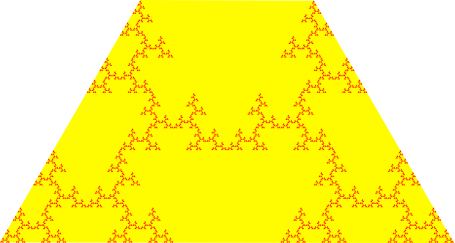
Fig.
3.11: Eleventh Step
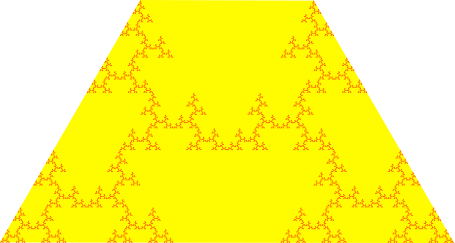
Fig.
3.12: Twelfth Step
4
Animation

Fig.
4: Animation
Weblink
Hans Walser: Goldenes Fraktal
https://walser-h-m.ch/hans/Miniaturen/G/Goldenes_Fraktal/Goldenes_Fraktal.html
References
Walser, Hans (2024): Der Goldene Schnitt.
Geometrische und zahlentheoretische Betrachtungen. 7. Auflage. Springer
Spektrum.
Print-ISBN 978-3-662-68556-3. E-Book_ISBN
978-3-662-68557-0.
https://doi.org/10.1007/978-3-662-68557-0
Walser, Hans (2024): The Golden
Ratio. Geometric and Number Theoretical Considerations. Springer. ISBN 978-3-662-69889-1, ISBN
978-3-662-69890-7 (eBook)
https://doi.org/10.1007/978-3-662-69890-7