Hans
Walser, [20260522]
Dodecagon Dissection
1
What
it's about
Dissection
of equiangular dodecagons into equilateral triangles and squares of equal side
length
Fibonacci
numbers
2
Classical
dodecagon
Figure 1
shows a dissection of the regular dodecagon into twelve equilateral triangles
and six squares of equal side length.

Fig.
1: Dissection of the regular dodecagon
The dissection
can be divided into a kernel and a ring (Fig. 2).
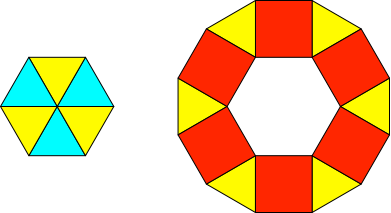
Fig.
2: Kernel and ring
3
Extension
We extend
the regular dodecagon by adding another ring (Fig. 3). The ring has a thickness
of 1.

Fig.
3: Extension by a ring
The
resulting dodecagon is no longer regular. The sides alternate between lengths
of 1 and 2. However, the dodecagon is equiangular.
4
Extensions
We now
extend with a ring of thickness 2 (Fig. 4). The small squares in the extension
ring combine to form a larger square.

Fig.
4: Extension with a ring of thickness 2
The next
extension has a thickness of 3 (Fig. 5).
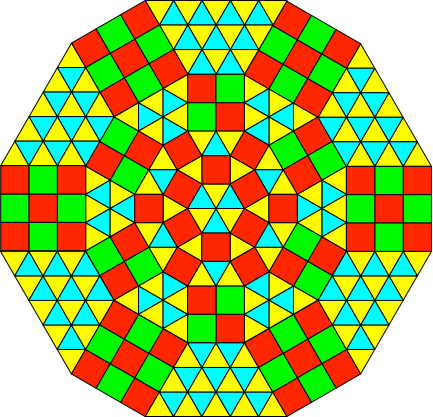
Fig.
5: Extension with a ring of thickness 3
The next
extension has a thickness of 5 (Fig. 6).

Fig.
6: Extension with a ring of thickness 5
The next
extension has a thickness of 8 (Fig. 7).
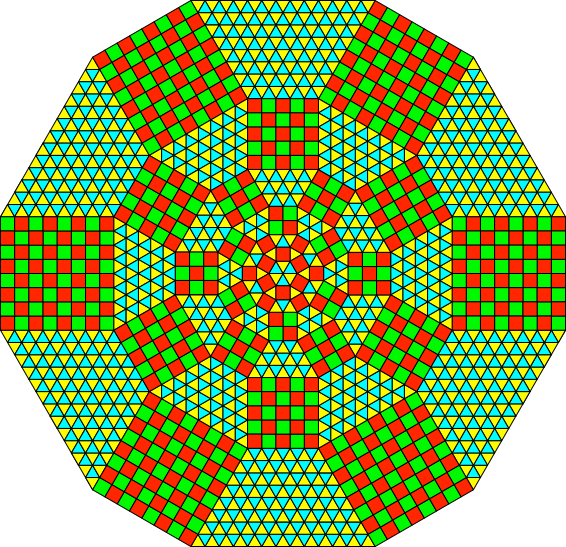
Fig.
7: Extension with a ring of thickness 8
5
Fibonacci
Numbers
In each
extension step, the small squares combine in a checkerboard pattern to form a
larger square. The thicknesses of the extension rings are:
1, 1, 2, 3, 5, 8
This is
the beginning of the Fibonacci sequence.
Isoceles
trapezoids lie between the checkerboard-like squares. Their side lengths are
three consecutive numbers in the Fibonacci sequence (Fig. 8).
Explanation:
The first two expansion steps have a thickness of 1.
From the
isosceles trapezoids, we can read off the Fibonacci recursion (Fig. 8).

Fig.
8: Fibonacci recursion