Hans
Walser, [20260523]
Dodecagon Dissection
1
What
it's about
Dissection
of regular dodecagons with side length n into equilateral triangles and
squares with the same side length
2
Classical
Dodecagon
Figure 1
shows a dissection of the regular dodecagon into twelve equilateral triangles
and six squares with the same side length.

Fig.
1: Regular dodecagon with side length 1
3
Rings
Figure 2
shows a ring whose inner contour corresponds to the outline of the regular
dodecagon with side length 1 (Fig. 1). However, the outer contour is not a
regular dodecagon. The sides have alternating lengths of 1 and 2.
The
second ring in Figure 2, conversely, has a dodecagon as its inner contour with
alternating side lengths of 1 and 2. The outer contour is a regular dodecagon
with side length 2.

Fig.
2: Rings
The two
rings can be nested inside each other to form a double ring, whose inner and
outer contours are each a regular dodecagon.
Similarly,
we can construct such a double ring for each side length (Figs. 3 to 5).

Fig.
3: Outer side length 3

Fig.
4: Outer side length 4
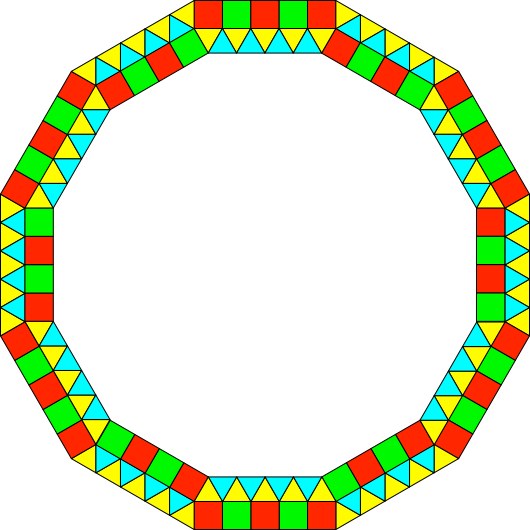
Fig.
5: Outer side length 5
These
double rings are all constructed according to the same pattern. We can
construct such a double ring for each side length n.
4
Combinations
We can
now connect such double rings together, thus obtaining a dissection of a
regular dodecagon with side length n.
However,
two double rings can be connected in two different ways (Fig. 6).
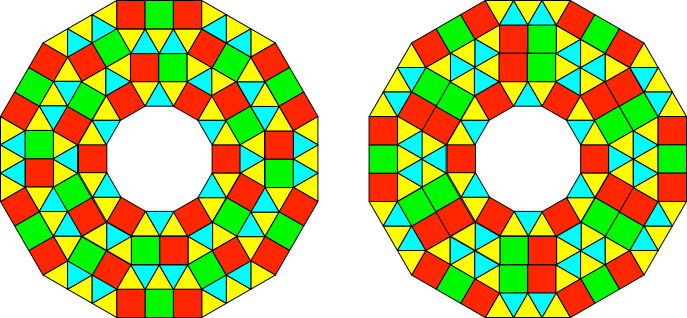
Fig.
6: Two ways of connecting
In the
second example, the outer double ring has been rotated by 30°.
For a
dodecagon with side length n, including the innermost dodecagon, there
are a total of n double rings involved. We therefore have n – 1 (“fence
post problem”) possibilities of a relative rotation. According to our method,
there are thus 2n–1 possible solutions.
Figures 7 and 8 show two extreme solutions.

Fig.
7: Solution without rotations
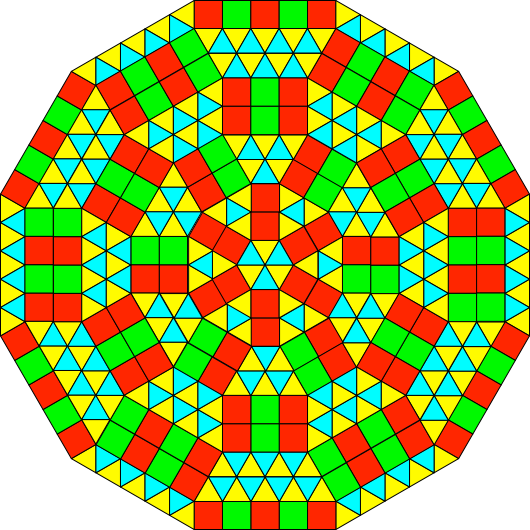
Fig.
8: Solution with four relative rotations
Weblinks
Hans
Walser: Dodecagon Dissection
https://walser-h-m.ch/hans/Miniaturen/Z/Zwoelfeck-Zerlegung/Dodecagon_Dissection.html