Hans Walser, [20260520]
Fibonacci
Spirals
Thanks to
Shingo Nakanishi, OIT (Osaka Institute of Technology), Japan
1
What
it's about
Spirals
with isosceles trapezoids whose side lengths correspond to the Fibonacci
numbers.
2
The
Fibonacci Trapezoids
We draw
the Fibonacci trapezoids (Fig. 1) on a regular triangular grid. The trapezoids
are isosceles and have three consecutive Fibonacci numbers as their sides. We
work with the following numbers from the Fibonacci sequence:
–1, 1, 0, 1, 1, 2, 3, 5, 8, 13, …
The
isosceles trapezoid on the far right, for example, has a base length of 13, a
leg length of 8, and a top side length of 5. The three consecutive Fibonacci
numbers are therefore 5, 8, 13.

Fig.
1: Fibonacci Trapezoids
The
"trapezoid" on the far left belongs to the triple –1, 1, 0. The base
length is –1, the leg length is 1, and the top side length is 0.
The adjoining
segment belongs to the triple 1, 0, 1.
The next
triangle belongs to the triple 0, 1, 1.
The first
true trapezoid belongs to the triple 1, 1, 2.
3
A
Spiral
We
construct a spiral from the trapezoids in Figure 1 (Fig. 2). It fits into the
triangular grid.
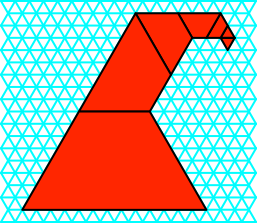
Fig.
2: Spiral made of trapezoids
4
Six
spirals
We can
combine six spirals from Figure 2 so that they cover the entire plane but do
not overlap (Fig. 3).
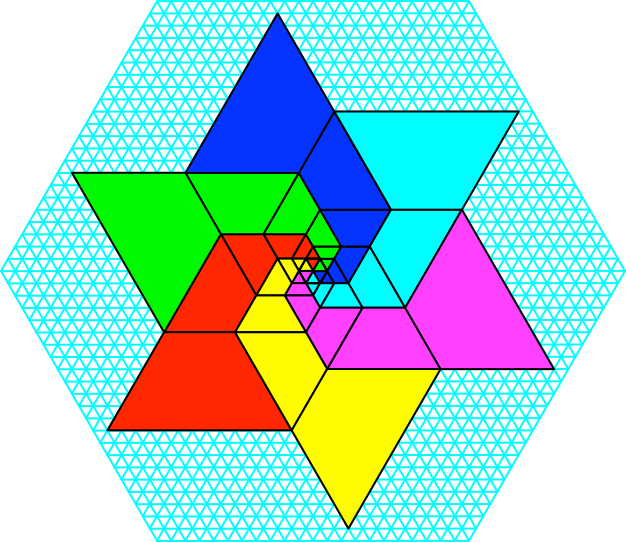
Fig.
3: Six spirals
In Figure
4, only the boundary lines are drawn. We can see two opposing spiral types.
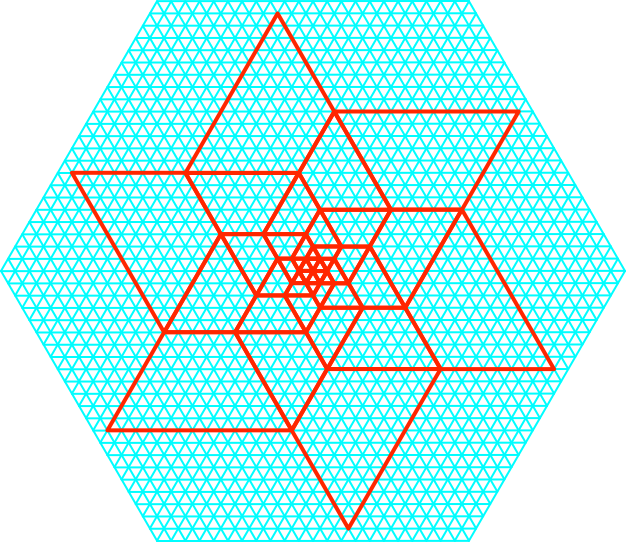
Fig.
4: Boundary lines
Figures 5
and 6 show the spiral types individually.
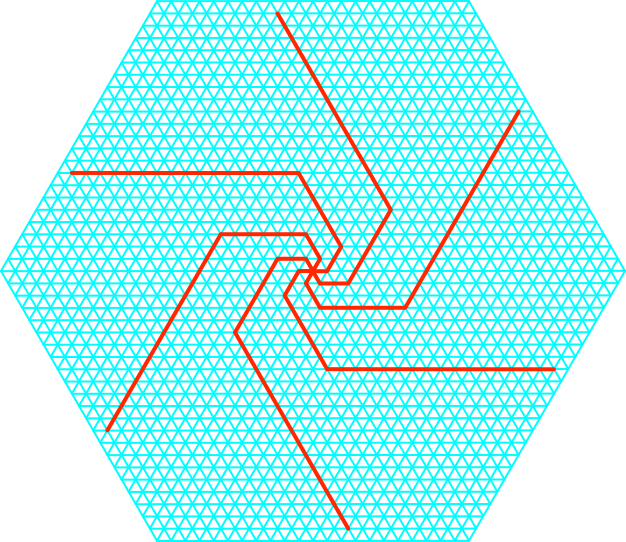
Fig.
5: Line spirals
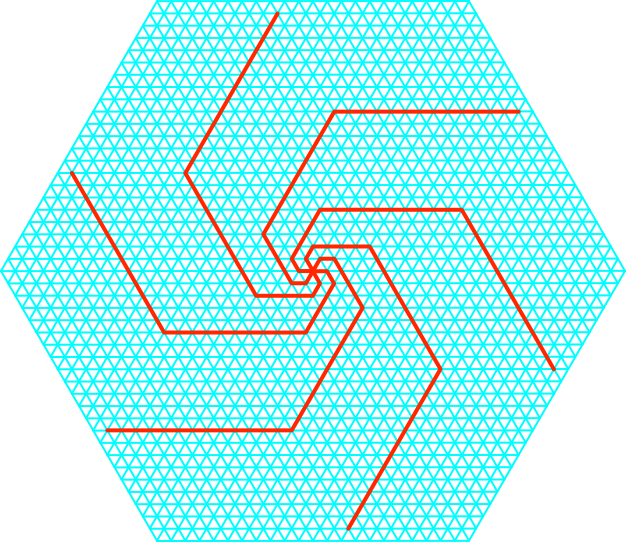
Fig.
6: Line spirals
Figure 7
shows the six area spirals without the background grid.
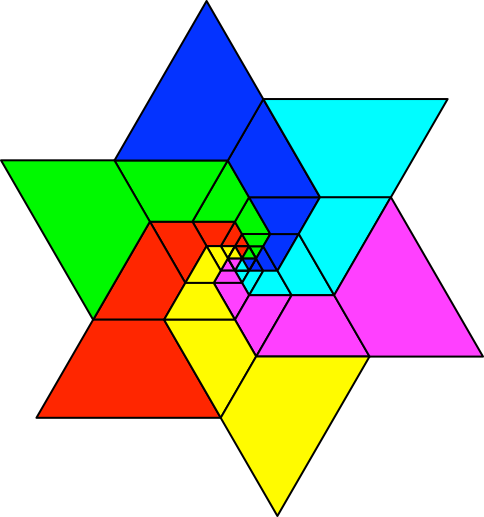
Fig.
7: Six area spirals without a grid
5
Another
spiral
The
spiral in Figure 8 contains right angles and therefore no longer fits into a
triangular grid.
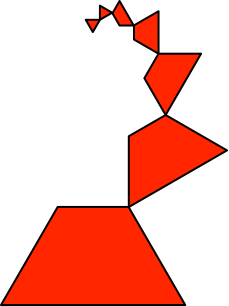
Fig.
8: Spiral with right angles
We can
combine six such spirals (Fig. 9). The gaps between are squares with side
lengths corresponding to the Fibonacci numbers.
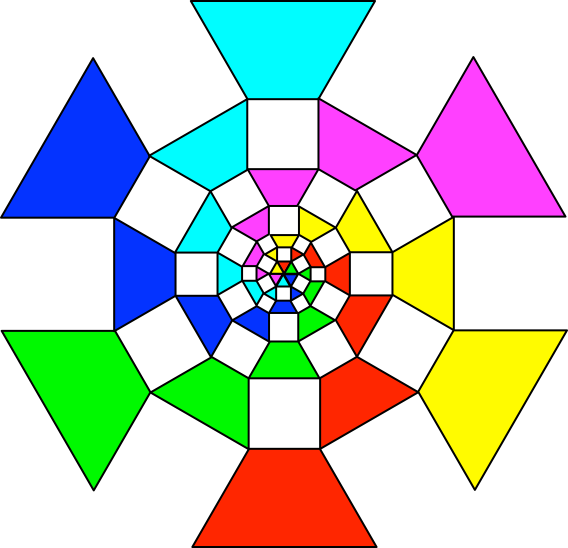
Fig.
9: Six spirals with gaps between them
6
Alternating
Coloring and Diagonals
We color
the figures in Figure 1 alternately red and green and add diagonals to the
trapezoids, running from the top left to the bottom right (Fig. 10).
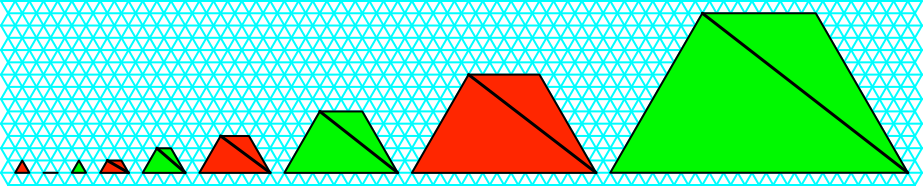
Fig.
10: Alternating Coloring. Diagonals
We can
stack all the red or all the green figures on top of each other to obtain an
equilateral triangle (Fig. 11).
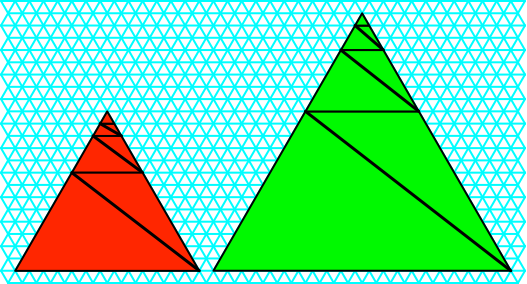
Fig.
11: Stack
We can
also arrange the pieces so that the diagonals form the beginning of a spiral
(Fig. 12).
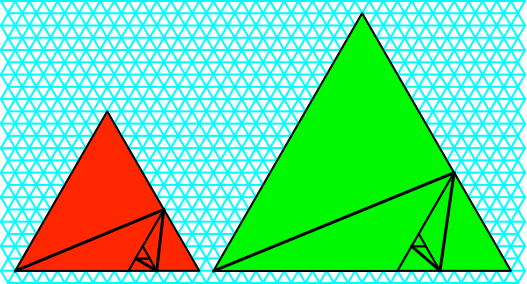
Fig.
12: Spirals
Figure 13
shows the same spirals with three additional steps each.
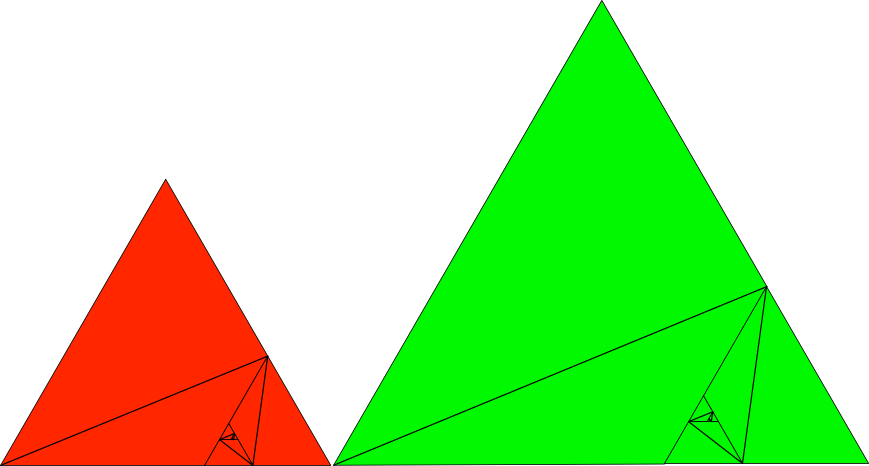
Fig.
13: Three Additional Steps Each
We can
also alternate between the colors red and green (Fig. 14).
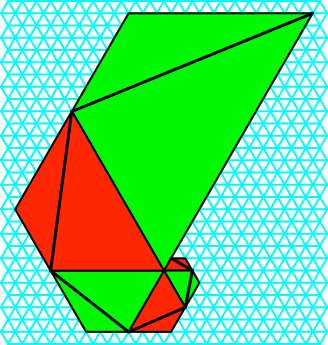
Fig.
14: Red/green spiral
Weblinks
Hans Walser:
Fibonacci Spirals
https://walser-h-m.ch/hans/Miniaturen/F/Fibonacci_Spirals2/Fibonacci_Spirals2.html
Hans Walser: Fibonacci-Spiralen
https://walser-h-m.ch/hans/Miniaturen/F/Fibonacci-Spiralen/Fibonacci-Spiralen.html
Hans Walser: Fibonacci-Star
https://walser-h-m.ch/hans/Miniaturen/F/Fibonacci-Star/Fibonacci_Star.htm
Hans Walser: Fibonacci-Trapeze
https://walser-h-m.ch/hans/Miniaturen/F/Fibonacci-Trapeze/Fibonacci-Trapeze.htm
References
Walser, Hans (2024): Spirals,
Helical Lines, and Spiral-Like Figures. Mathematical Playfulness in Two and
Three Dimensions. Springer.
ISBN 978-3-662-68930-1, ISBN 978-3-662-68931-8 (eBook)
https://doi.org/10.1007/978-3-662-68931-8
Walser, Hans (2012): Fibonacci. Zahlen und Figuren. Leipzig, EAGLE, Edition am Gutenbergplatz. ISBN 978-3-937219-60-8.