Hans
Walser, [20260529]
Fibonacci
Trapezoids
1
What
it's about
A
construction using equilateral triangles that leads to isosceles trapezoids in
the context of a generalized Fibonacci sequence.
2
Generalized
Fibonacci sequence
The
starting values f1 and f2 are arbitrary.
The recursion is the standard Fibonacci recursion:
(1) fn+1
= fn + fn–1
3
Visualizing
the recursion
We draw
an isosceles trapezoid with base angles of 60°. The upper parallel side has a
length of fn–1, and the
leg length is fn (Fig. 1). Using a
red dividing line parallel to one leg, we divide the trapezoid into an
equilateral triangle with side length fn
and a parallelogram with side lengths fn
and fn–1. This shows
that the lower parallel side has a length of fn+1.
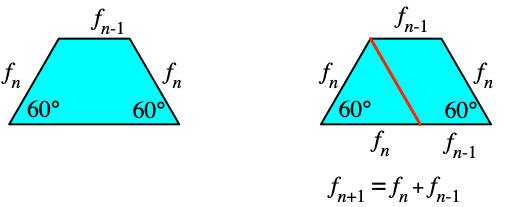
Fig.
1: Isosceles Trapezoid
We now
rotate the trapezoid by +120° and by –120° and join the two rotated trapezoids
at one vertex (Fig. 2).
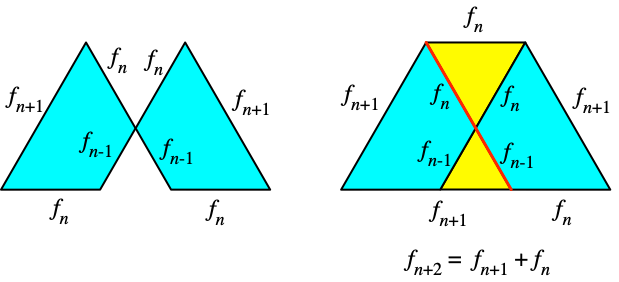
Fig.
2: Iteration Step
The
convex hull of the figure is again an isosceles trapezoid with base angles of
60°. The upper parallel side now has length fn,
and the leg length is fn+1. The lower parallel
side has length fn+2.
These
considerations are independent of the two initial values f1
and f2.
4
Example
4.1 Initial Values and Sequence
For the
figures in the following example, we work with the two initial values f1
= 2 und f2 = 5. Table 1 gives the corresponding generalized
Fibonacci sequence.
|
n |
fn |
|
|
1 |
2 |
Starting value |
|
2 |
5 |
Starting value |
|
3 |
7 |
|
|
4 |
12 |
|
|
5 |
19 |
|
|
6 |
31 |
|
|
7 |
50 |
|
|
8 |
81 |
|
|
9 |
131 |
|
|
10 |
212 |
|
Table
1: Generalized Fibonacci sequence
4.2 Base trapezoid
We begin
with an isosceles base trapezoid (Fig. 3) with the upper parallel side f1
= 2 and leg length f2 = 5. By tiling the base trapezoid with
equilateral triangles of side length 1, the side lengths of the trapezoid can
be read directly. The lower parallel side has a length f3 = 7. The number of equilateral triangles is 45.
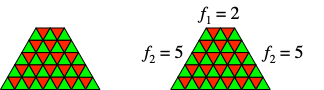
Fig.
3: Base trapezoid
4.3 Iterations
Using the
base trapezoid, we perform the iteration step described above (Fig. 4.1). The
new trapezoid has an area equivalent to 119 equilateral triangles with side
length 1.
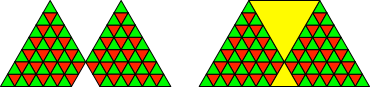
Fig.
4.1: First Step
Figures
4.2 to 4.5 show the next iterations. Figure 4.5 has been reduced in size for
space reasons.
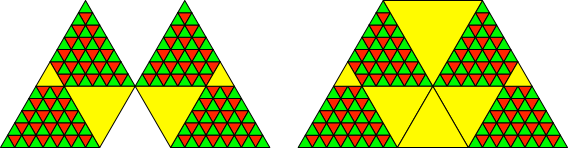
Fig.
4.2: Second Step
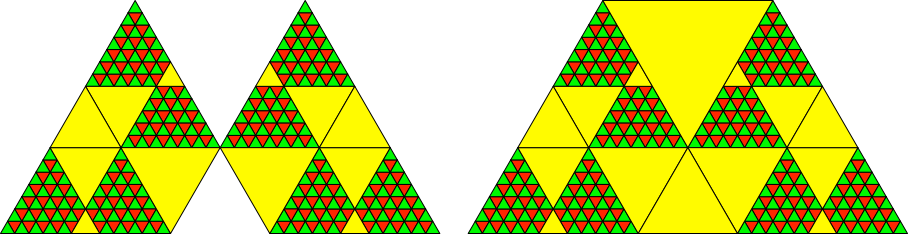
Fig.
4.3: Third Step
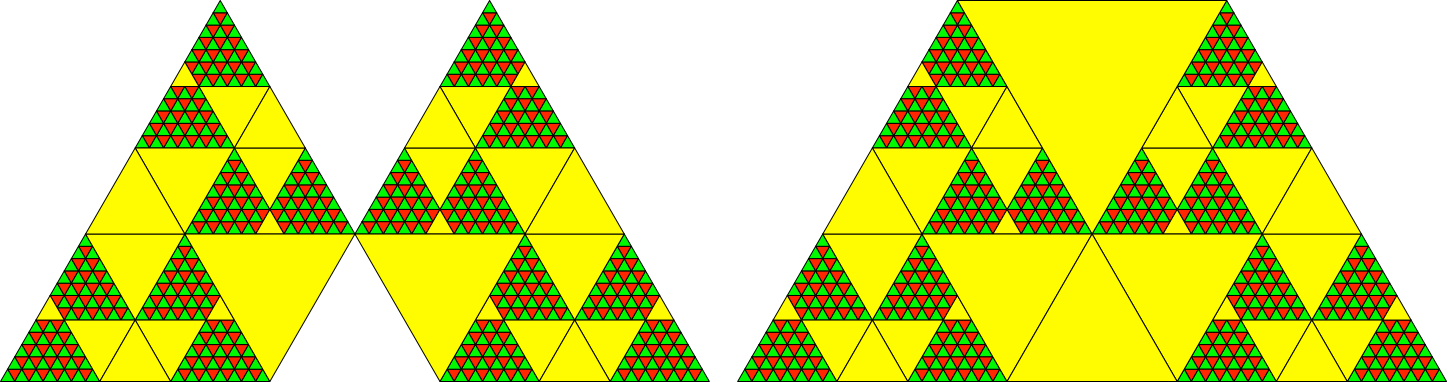
Fig.
4.4: Fourth Step
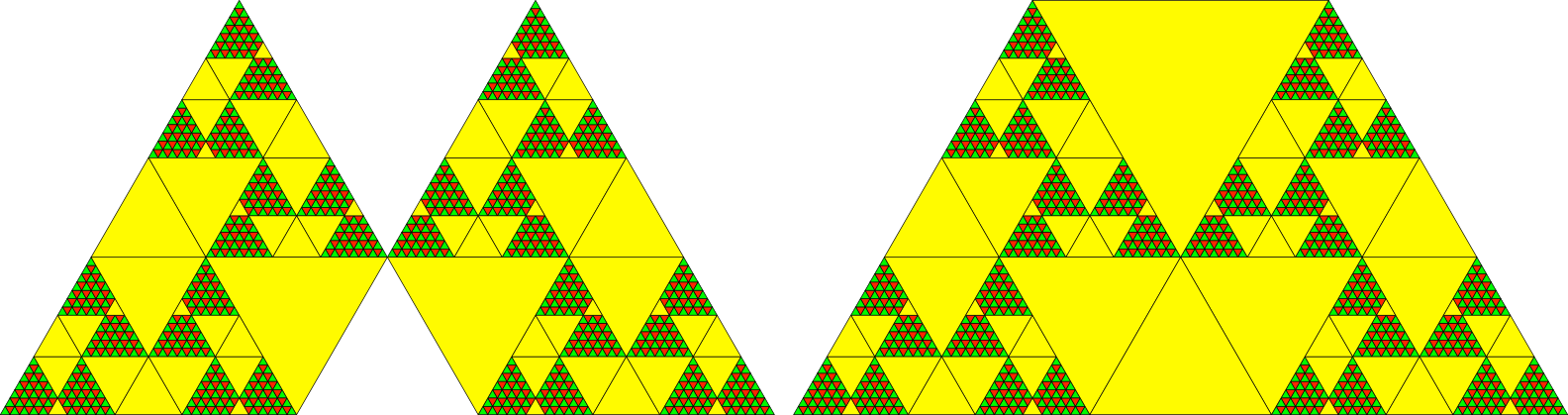
Fig.
4.5: Fifth Step
4.4 Number of Small Triangles
Table 2 gives
the number of small triangles.
|
n |
fn |
An |
|
1 |
2 |
45 |
|
2 |
5 |
119 |
|
3 |
7 |
312 |
|
4 |
12 |
817 |
|
5 |
19 |
2139 |
|
6 |
31 |
5600 |
|
7 |
50 |
14661 |
|
8 |
81 |
38383 |
|
9 |
131 |
100488 |
|
10 |
212 |
263081 |
Table
2: Number of small triangles
The
number of small triangles An can be
calculated as follows:
(2) An
= (fn + fn+2)
fn+1
(3) An
= fn+22 – fn2
Weblinks
Hans Walser: Fibonacci-Trapeze
https://walser-h-m.ch/hans/Miniaturen/F/Fibonacci-Trapeze/Fibonacci-Trapeze.htm
Hans Walser: Fibonacci-Trapeze
https://walser-h-m.ch/hans/Miniaturen/F/Fibonacci-Trapeze2/Fibonacci-Trapeze2.html
Hans Walser: Fibonacci Trapezoids
https://walser-h-m.ch/hans/Miniaturen/F/Fibonacci-Trapeze2/Fibonacci_Trapezoids2.html
Hans Walser: Goldenes Fraktal
https://walser-h-m.ch/hans/Miniaturen/G/Goldenes_Fraktal2/Goldenes_Fraktal2.html
Hans Walser: Golden Fractal
https://walser-h-m.ch/hans/Miniaturen/G/Goldenes_Fraktal2/Golden_Fractal.html